

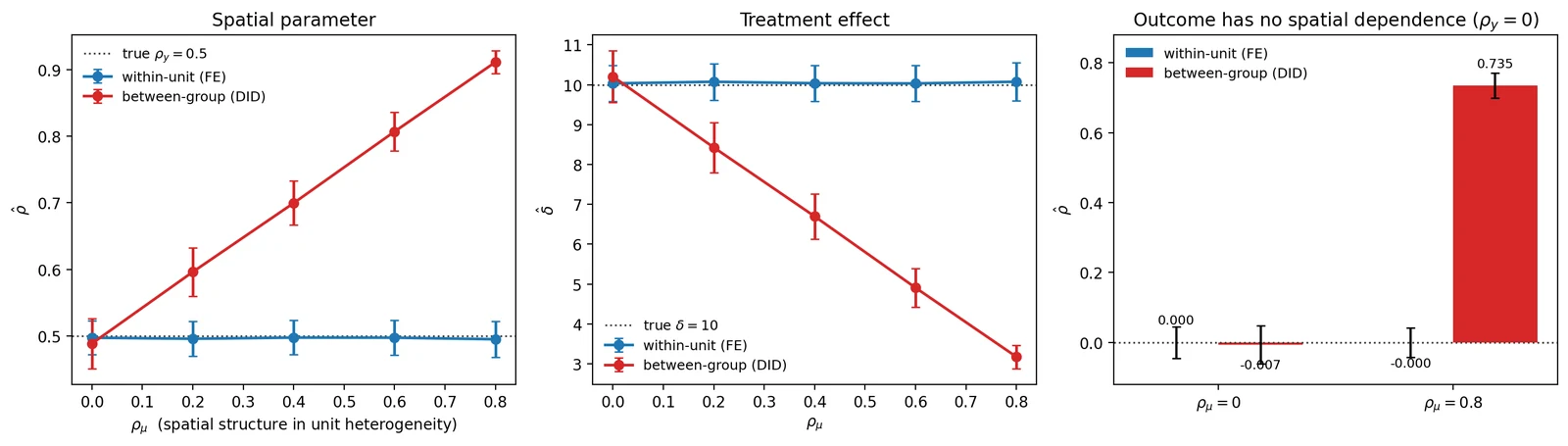
Applied work estimates the effect of a place-based treatment, such as a new transit line or a regulatory boundary, with difference-in-differences or fixed effects, and treats the choice between them as immaterial. The two designs are numerically identical for an unstaggered treatment in a balanced two-period panel, but only in the aspatial case. When the outcome is spatially dependent, the spatial multiplier is itself a function of location, so a period shock that varies across space produces a differential trend correlated with treatment by construction. The conditions under which parallel trends survive cannot be tested with two periods, and an explicit spatial model is required.
Adding one does not rescue difference-in-differences. The spatial parameter is identified from the residual variation that separates unit-level from group-level conditioning, and the treatment effect depends on it. In simulation, the between-group design understates the effect by up to 68 percent and reports a spatial parameter of 0.735 where the outcome has none. On Montgomery County rents around the announcement of the Purple Line, a light-rail line in suburban Maryland, it returns the larger spatial parameter in all 124 comparisons. The announcement moved rents little, and only the spatial fixed-effects design recovers that estimate.