

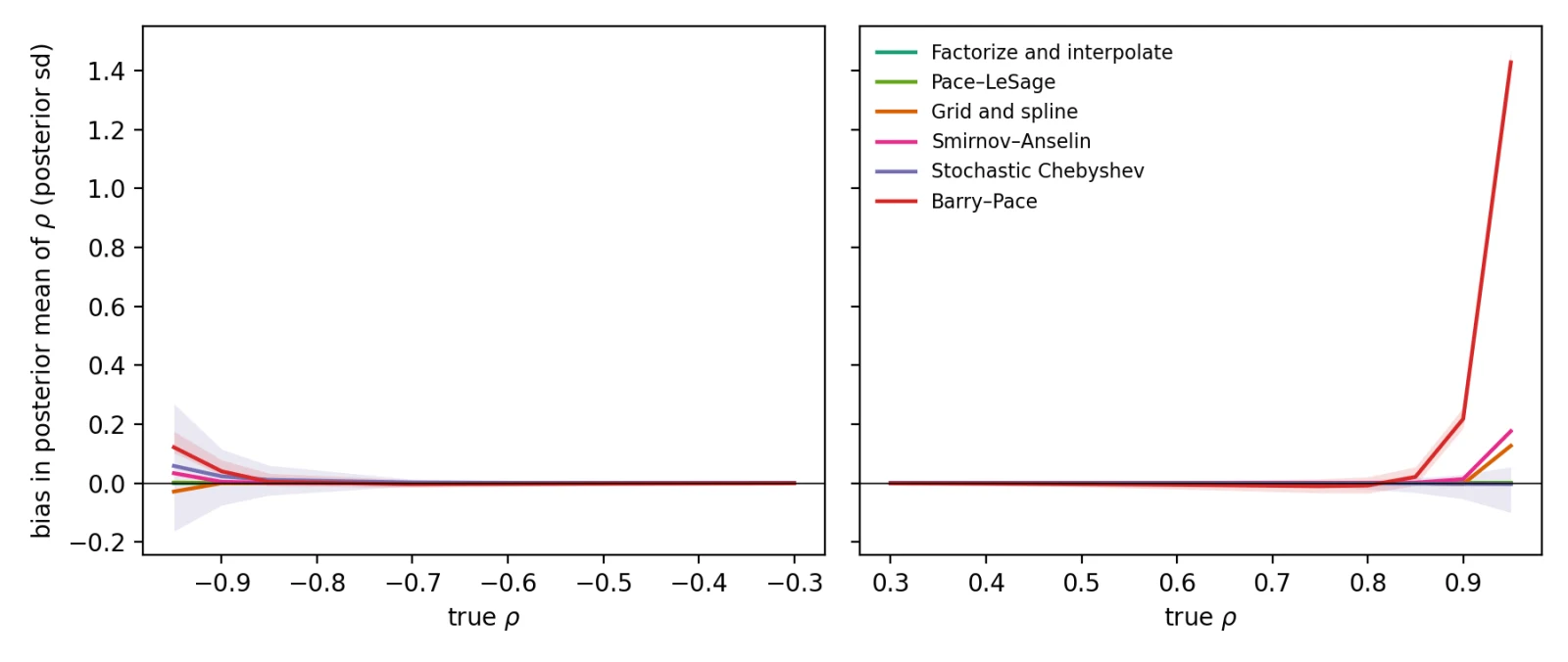
Fitting a spatial autoregressive model means evaluating the log-determinant of its Jacobian over and over, thousands of times in a Bayesian sampling run, and that cost has long limited the sample sizes the models reach. The paper introduces two methods. The first treats the log-determinant as an analytic function of the autoregressive parameter and interpolates it with the AAA algorithm; it suits most spatial weights matrices, directed or undirected. The second is matrix-free, built on stochastic Chebyshev traces, for weights that are dense or have hub-and-spoke structure. Both stay unbiased as the autoregressive parameter approaches the edge of its stability region, where the most scalable methods in current use do not.
With them, a Bayesian spatial autoregressive model of all 85,230 U.S. census tracts needs about a second of Jacobian computation per chain of 2,000 draws, where the next-best unbiased method takes several minutes. The methods ship in neighbayes.