

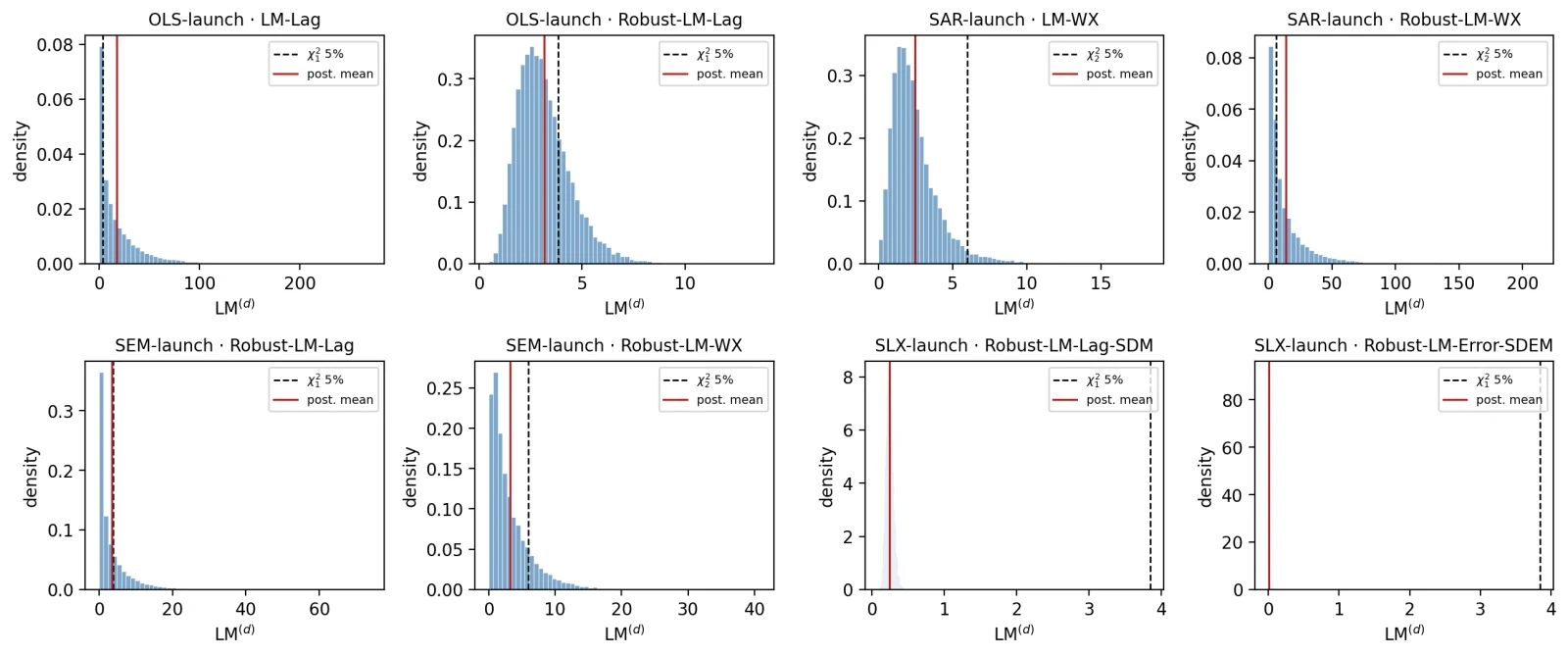
Lagrange-multiplier tests are the standard misspecification diagnostics of spatial econometrics, but models fit by Markov chain Monte Carlo have had no equivalent: analysts either refit a frequentist model at the posterior mean or compare marginal likelihoods, which is expensive. The paper builds the Bayesian counterpart. One template, a score evaluated on each posterior draw of the restricted model, reproduces the classical diagnostics for cross-sectional models and extends without structural change to the spatial Durbin family, static spatial panels, and origin–destination flow models. Each statistic carries a full posterior distribution, so the test reports its own uncertainty.
The tests ship in neighbayes.